

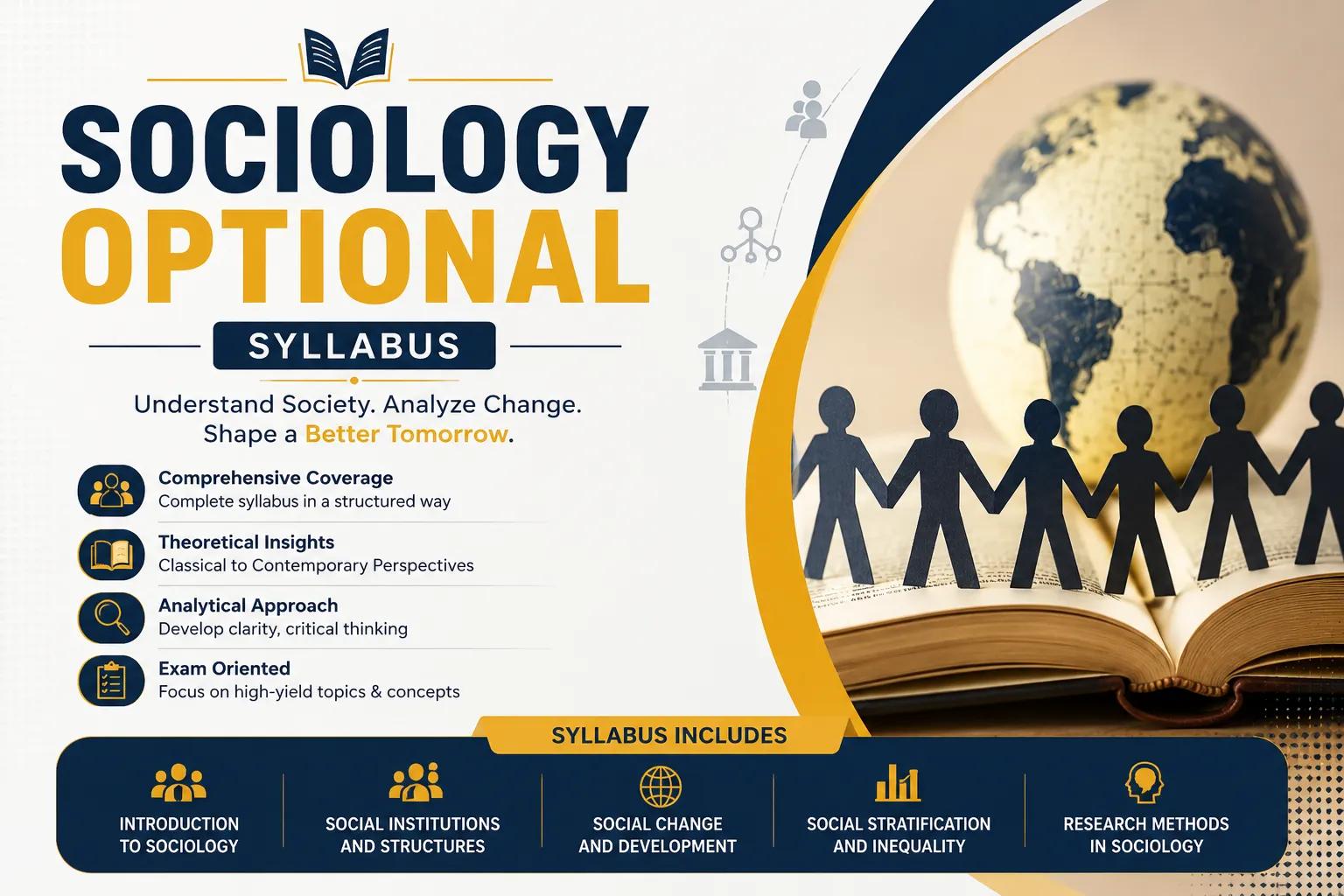
sociology optional syllabus
Choosing Sociology as an optional subject for the UPSC Civil Services Examination can be a strategic decision for aspirants who have an interest in society, social institutions, human relationships, and contemporary issues. However, understanding the sociology optional syllabus is essential before beginning preparation. A clear knowledge of the syllabus helps candidates organize their studies, identify important topics, and develop an effective answer-writing strategy.
Understanding the Sociology Optional Syllabus
The Sociology optional subject for UPSC is divided into two papers. Both papers carry equal marks and test a candidate's conceptual understanding, analytical ability, and application of sociological perspectives to real-world situations.
The syllabus broadly covers sociological thinkers, research methods, social institutions, social change, Indian society, social structure, and contemporary social issues. Aspirants should study every topic systematically rather than focusing only on frequently discussed areas.
Paper I: Fundamentals of Sociology
Paper I primarily focuses on the basic concepts and theoretical foundations of sociology. It helps candidates understand how sociologists study society and interpret social behavior.
1. Sociological Thinkers
One of the most important components is the study of classical and modern sociological thinkers. Candidates generally need to understand the ideas and contributions of thinkers such as Karl Marx, Emile Durkheim, Max Weber, Talcott Parsons, Robert K. Merton, and others.
Rather than simply memorizing theories, aspirants should understand key concepts, arguments, criticisms, and contemporary applications. Using thinkers effectively in answers can add analytical depth.
2. Research Methodology
Research methods form another significant part of the syllabus. Candidates should understand concepts such as scientific methods, research design, qualitative and quantitative approaches, sampling, observation, interviews, questionnaires, and case studies.
Aspirants should also understand the importance of objectivity, reliability, validity, and ethical considerations in sociological research.
3. Basic Sociological Concepts
The syllabus includes several fundamental concepts that form the foundation of sociology. These include social groups, status and role, socialization, culture, social control, stratification, mobility, power, authority, and social institutions.
A strong understanding of these concepts is useful because they can be applied across different questions and topics.
Paper II: Indian Society and Social Structure
Paper II focuses specifically on Indian society. It connects sociological concepts with India's historical development, social structure, institutions, and contemporary challenges.
1. Indian Social Structure
Aspirants should study important features of Indian society, including caste, class, tribes, family, kinship, religion, and regional diversity. The syllabus also examines the changing nature of these institutions under the influence of modernization, urbanization, education, and economic development.
2. Caste and Social Stratification
Caste remains an important area of Indian sociology. Candidates should understand the traditional features of the caste system as well as contemporary changes in caste relationships.
Topics such as social mobility, dominant caste, affirmative action, caste politics, and changing patterns of inequality can provide useful dimensions for analytical answers.
3. Family, Marriage, and Kinship
Indian family and kinship systems are also important components. Aspirants should examine changes in family structures, marriage patterns, gender relationships, household arrangements, and the impact of modernization and urbanization.
4. Social Change in India
The sociology optional syllabus gives considerable importance to processes of social change. Candidates should understand concepts such as modernization, westernization, secularization, globalization, industrialization, and urbanization.
It is particularly useful to connect theoretical concepts with current developments in Indian society.
Contemporary Social Issues
Another important component involves contemporary social challenges. Aspirants should prepare topics such as poverty, unemployment, population issues, migration, urbanization, education, health, gender inequality, communalism, regionalism, and environmental concerns.
These topics provide opportunities to combine sociological theories with examples from current affairs. Relevant government initiatives, reports, social movements, and recent developments can make answers more comprehensive.
Importance of Answer Writing
Knowing the syllabus alone is not enough. UPSC Sociology requires candidates to present ideas logically and analytically. Aspirants should practice writing answers within the prescribed time while incorporating definitions, thinkers, concepts, examples, diagrams, and contemporary illustrations where appropriate.
A well-structured answer generally includes an introduction, a logical body with multiple dimensions, and a balanced conclusion. Regular practice helps improve both speed and presentation.
How to Prepare the Sociology Optional Syllabus
Candidates should begin by thoroughly reading the official syllabus and dividing it into smaller topics. Standard sociology books and reliable study materials can then be used to build conceptual clarity.
Creating short notes, revising thinkers, practicing previous-year questions, and linking Paper I concepts with Paper II examples can significantly improve preparation. Previous-year questions are especially valuable because they help aspirants understand the nature and expectations of UPSC questions.
Conclusion
The sociology optional syllabus provides a structured framework for understanding society from both theoretical and Indian perspectives. From classical sociological thinkers and research methodology to caste, family, social change, and contemporary issues, the syllabus offers a wide range of topics for analytical study.
For aspiring scholars and UPSC candidates, the key is not merely completing the syllabus but developing conceptual clarity and the ability to apply sociological perspectives to real-world situations. With systematic preparation, regular revision, and consistent answer-writing practice, Sociology can become a well-organized and rewarding optional subject.